Yesterday, I finally understood the difference between:
- Databases
- Data Warehouses
- Data Lakes
I felt pretty confident.
Then I opened today’s lesson and immediately got confused again.
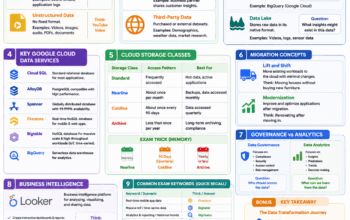
Google Cloud offers:
- Cloud SQL
- AlloyDB
- Spanner
- BigQuery
My first thought was:
Aren’t these all just databases?
The answer turned out to be no.
And understanding why actually helped me understand something bigger:
Different businesses have completely different data needs.
One Size Doesn’t Fit All
Imagine three different businesses.
Business #1: A Local Clothing Store
The store needs to track:
- Customers
- Orders
- Inventory
- Payments
Nothing fancy.
No millions of users.
No global traffic.
They simply need a reliable database that works.
This is where Cloud SQL fits perfectly.
Cloud SQL: The Reliable Everyday Choice
Cloud SQL is a fully managed relational database service.
The important part isn’t the technology.
The important part is what it saves you from doing.
Google handles things like:
- Backups
- Updates
- Patches
- Maintenance
Instead of spending time managing databases, teams can focus on building applications.
Think Of Cloud SQL As
🚗 A reliable family car.
It does exactly what most organizations need without unnecessary complexity.
Business #2: A Fast-Growing Startup
Now imagine the clothing store becomes a successful online brand.
Traffic increases.
Transactions increase.
The application becomes more demanding.
The company already uses PostgreSQL and doesn’t want to rewrite everything.
But they need more performance.
This is where AlloyDB comes in.
AlloyDB: PostgreSQL, But Faster
One thing that surprised me was that AlloyDB is fully compatible with PostgreSQL.
That means organizations can keep using familiar tools and skills.
At the same time, Google improves performance dramatically.
Why Companies Choose AlloyDB
- PostgreSQL compatibility
- Higher performance
- High availability
- Better support for demanding workloads
Think Of AlloyDB As
🏎️ A performance version of PostgreSQL.
Same driving experience.
Much faster engine.
Business #3: A Global Company
Now let’s imagine something much larger.
A company operates in:
- India
- Europe
- North America
- Australia
Millions of users are placing transactions at the same time.
The company can’t afford downtime.
And every customer must see consistent information regardless of location.
This is where things become much harder.
And this is exactly the problem Spanner was designed to solve.
Spanner: Built for Global Scale
This was probably the most impressive product I learned about today.
Spanner provides:
- Relational database capabilities
- Horizontal scaling
- Global consistency
- 99.999% availability
That’s why Google uses it for many of its own critical systems.
Think Of Spanner As
🌍 A database designed for the entire world.
Not just one application.
Not just one country.
The whole world.
Then I Met BigQuery
At first, I assumed BigQuery was another database.
But this is where today’s lesson became interesting.
BigQuery isn’t primarily about running applications.
It’s about answering questions.
Imagine a CEO asking:
- Which products sold best last year?
- Which region generated the most revenue?
- What customer trends are emerging?
That’s not a transactional database problem.
That’s an analytics problem.
BigQuery: Where Data Becomes Decisions
BigQuery is a data warehouse designed for analytics.
Instead of handling day-to-day transactions, it helps organizations analyze massive amounts of data.
And one thing I keep noticing throughout this course is that data becomes valuable when it helps people make decisions.
That’s exactly what BigQuery is built for.
Think Of BigQuery As
📊 The company’s intelligence center.
It doesn’t just store information.
It helps organizations understand it.
The Simple Way I Remember Them
| Service | How I Think About It |
|---|---|
| Cloud SQL | Reliable relational database |
| AlloyDB | PostgreSQL with extra performance |
| Spanner | Global-scale database |
| BigQuery | Analytics and business insights |
Quick Knowledge Check 🧠
Question 1
A company needs:
- Global consistency
- Massive scale
- 99.999% availability
Answer:
✅ Spanner
Question 2
A company wants PostgreSQL compatibility with much better performance.
Answer:
✅ AlloyDB
Question 3
A small application needs a fully managed relational database.
Answer:
✅ Cloud SQL
Question 4
A business wants to analyze years of sales data and identify trends.
Answer:
✅ BigQuery
My Biggest Takeaway
When I started today’s lesson, I thought Google Cloud had several products that all did the same thing.
What I learned is that each service solves a completely different business problem.
A local business doesn’t need the same database as a global enterprise.
And a company analyzing data doesn’t need the same tools as a company processing transactions.
The more I learn about cloud technology, the more I realize that choosing the right tool isn’t about finding the “best” product.
It’s about finding the right product for the job.