Today’s lesson completely confused me at first.
I kept seeing three terms:
- Database
- Data Warehouse
- Data Lake
And honestly?
They all sounded like different names for the same thing.
After all, aren’t they just places where data is stored?
Apparently not.
And the way I finally understood them was by imagining a shopping mall.
Imagine You Own a Large Shopping Mall
Every day, thousands of things happen.
Customers make purchases.
Security cameras record footage.
Visitors leave reviews online.
Sensors track parking availability.
The mall is generating data everywhere.
Now here’s the interesting question:
Where should all this information go?
The answer depends on what you’re trying to do with it.
The Database: Running Daily Operations
Imagine a customer walks into a clothing store and buys a shirt.
The store needs to know:
- Product name
- Price
- Quantity remaining
- Customer details
This information needs to be accurate and updated immediately.
This is what a Database is designed for.
A database helps businesses run their day-to-day operations.
Think:
- Orders
- Payments
- Customer accounts
- Inventory
Databases answer questions like:
“What is happening right now?”
Relational vs Non-Relational Databases
This was another thing that confused me.
Relational Databases
These love structure.
Think Excel spreadsheets.
| Product | Price |
|---|---|
| Shirt | ₹1000 |
| Shoes | ₹2500 |
Everything fits neatly into rows and columns.
Examples in Google Cloud:
- Cloud SQL
- Spanner
Non-Relational Databases (NoSQL)
Life isn’t always organized.
Imagine customer reviews:
“Loved the product!”
“Delivery was delayed.”
“Would buy again.”
Different formats.
Different structures.
Sometimes no structure at all.
That’s where NoSQL databases help.
Examples in Google Cloud:
- Bigtable
- Firestore
The Data Warehouse: The Mall’s Head Office
Now imagine the mall owner wants to answer questions like:
- Which stores generated the most revenue this year?
- Which season had the highest sales?
- Which products are becoming popular?
A normal database isn’t designed for this type of analysis.
This is where a Data Warehouse comes in.
Think of it as the mall’s headquarters.
It collects information from many sources and prepares it for reporting and business decisions.
Instead of focusing on today’s transaction, it focuses on trends.
Databases run the business.
Data Warehouses help improve the business.
The Data Lake: Store Everything
Then came the concept that surprised me the most.
A Data Lake.
Imagine the mall decides:
“Let’s keep everything.”
Not just sales records.
Everything.
- CCTV footage
- Customer reviews
- Social media posts
- Audio recordings
- Sensor data
- Website clicks
Instead of cleaning and organizing everything first, they simply store it.
That’s what a Data Lake does.
It stores raw data in its original format.
Structured.
Semi-structured.
Unstructured.
Everything.
The Easiest Way I Found to Remember Them
Database
Runs daily business operations.
Example:
A customer buys a shirt.
Data Warehouse
Analyzes historical business trends.
Example:
Which products sold the most last year?
Data Lake
Stores everything for future exploration.
Example:
Sales data + videos + reviews + sensor data.
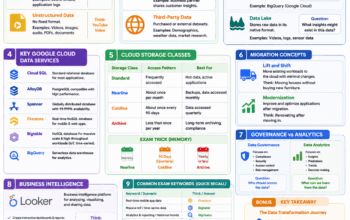
Where Do Google Cloud Services Fit?
This part looked intimidating at first because there were so many product names.
Instead of memorizing everything, I grouped them by purpose.
Database Services
Relational (SQL)
- Cloud SQL
- Spanner
Non-Relational (NoSQL)
- Bigtable
- Firestore
Data Warehouse Service
- BigQuery
This is Google’s serverless data warehouse used for analytics.
Data Lake Foundation
- Cloud Storage
This stores massive amounts of raw data like:
- Images
- Videos
- Audio
- Logs
Quick Knowledge Check 🧠
Question 1
A company wants to store customer transactions and inventory records.
Answer:
✅ Database
Question 2
A company wants to analyze five years of sales trends.
Answer:
✅ Data Warehouse
Question 3
A company wants to store videos, reviews, images, and raw logs for future analysis.
Answer:
✅ Data Lake
My Biggest Takeaway
When I started today’s lesson, I thought databases, data warehouses, and data lakes were just different storage technologies.
What I learned is that they solve completely different business problems.
A database helps run the business.
A data warehouse helps understand the business.
A data lake helps discover things the business doesn’t even know to ask yet.
And honestly, that’s a distinction I’ll probably remember long after the exam.